San Antonio requires all dogs to be on a leash any time they leave their owner’s property. That applies to public sidewalks, parks, walking trails, and any other area outside your fenced yard. The rule comes from Municode Chapter 5, Article I, Section 5-19 of the San Antonio Code of Ordinances, and enforcement falls to Animal Care Services (ACS), which has the authority to impound unrestrained dogs even from unenclosed front yards.
Fines start at $100 for a first offense and can reach $2,000. A second offense carries a minimum $200 fine. Third and subsequent offenses carry a minimum $300 fine.
This guide covers the ordinance in plain language, where dogs can legally go off-leash, how fines work, what HOA rules add on top of city rules, and how professional dog walkers operate within these requirements across Greater San Antonio.
What San Antonio’s Leash Law Actually Says
The specific language in Municode Chapter 5, Article I, Section 5-19 is direct: “An animal owner or keeper shall not walk an animal without a leash restraint.”
When a dog is not on a leash, it must be confined to the owner’s property at all times, whether that means inside a fenced yard, in the home, or in a properly secured enclosure.
Dogs not under restraint are considered “at large.” A dog running at large in San Antonio creates liability for the owner regardless of the dog’s temperament. A calm dog that approaches another person or dog can still generate a citation.
Enforcement: Animal Care Officers have the legal authority to enter unenclosed front yards of private property to impound unrestrained animals. This is not limited to public sidewalks or parks. If your dog is loose in your unfenced front yard, an ACS officer can legally impound it without stepping through a gate.
ℹ️ Animal Care Officers can enter your unfenced front yard.
Under San Antonio’s ordinance, ACS officers have authority to impound unrestrained animals from unenclosed front yards without needing to pass through a gate. A dog loose in an unfenced front yard is considered “at large” even on private property. This applies regardless of the dog’s temperament or how close to the door it happens to be.
Reporting violations: Residents can report a dog running at large by calling 311 or (210) 207-6000. Animal Care Services operates 24 hours a day. When reporting, provide the dog’s description, the location, and any details about the owner if visible.
Fines for Violating San Antonio’s Leash Law
| Offense | Fine Range |
|---|---|
| First offense | $100 to $2,000 |
| Second offense | Minimum $200 |
| Third+ offense | Minimum $300 |
⚠️ A first-time leash law violation in San Antonio can cost up to $2,000.
The $2,000 ceiling is not a rare outcome reserved for serious incidents. Animal Care Officers have discretion in how they write citations, and factors like aggression toward another animal, injury, or prior contact with ACS can push a citation toward the higher end of the range even on a first offense. Fines for second and third offenses carry mandatory minimums and escalate from there.
Fines are issued for allowing a dog to run at large, failing to use a leash in public areas, and other Chapter 5 violations including unlicensed pets and expired rabies vaccinations.
The $2,000 ceiling on a first offense is not theoretical. Code enforcement officers have discretion in how they write citations, and factors like aggression, property damage, or injury to another person or animal can push a citation toward the higher end of the range.
Animal abandonment, which is a separate violation updated in September 2025, now carries fines of $500 to $2,000, with higher minimums for repeat offenses. Under state law, animal abandonment can also be prosecuted as a Class A misdemeanor or a felony.
Where Dogs Can Go Off-Leash in San Antonio
Designated, enclosed off-leash dog parks are the exception to the leash requirement. Within those fenced areas, dogs are permitted to run freely. However, the parks themselves have their own rules that owners must follow.
Off-leash dog parks in the San Antonio park system include:
- Hardberger Park (north side, near Blanco Road) – one of the larger dog park areas in the city
- McAllister Park (northeast, near Starcrest) – multi-acre off-leash area
- Pearsall Park (south side) – dog-friendly with off-leash sections
- Lady Bird Johnson Park (southwest near Lackland) – off-leash area available
Standard dog park rules at San Antonio city parks:
- Dogs must be current on vaccinations
- Dogs must wear their license tag
- Owners must clean up waste immediately
- Aggressive dogs must be removed
- Children under 12 must be supervised by an adult
- No glass containers
A common misunderstanding: Having a designated off-leash area within a park does not mean the entire park is off-leash. Trails, open fields, and areas outside the fenced enclosure still require a leash. Brackenridge Park, for example, has beautiful trail systems where leashes are required at all times, even though the park is dog-friendly.
Friedrich Wilderness Park requires leashes on all trails. The natural terrain and wildlife make this a firm rule, not a suggestion.
Leash Laws and San Antonio’s Licensing Requirements
Leash compliance and licensing go hand in hand. Under City of San Antonio code, all dogs must be licensed by 16 weeks of age and renewed annually.
License fees:
- Sterilized animals: $5 per year
- Unsterilized (intact) animals: $50 per year
Proof of current rabies vaccination is required when obtaining a license. Rabies vaccination is required by 16 weeks of age, with a booster at 12 months, then every 1 to 3 years depending on the vaccine type used by your veterinarian.
Dogs should wear their license tag on their collar any time they are outside. If a dog is picked up by Animal Care Services, the tag is often how owners get their pets back quickly without a lengthy impoundment process.
Animal limits: The City of San Antonio allows a maximum of five dogs at a single residence within city limits. Households with more than five dogs may need a kennel permit or may be subject to additional regulations.
How Leash Laws Apply to Professional Dog Walkers and Pet Sitters
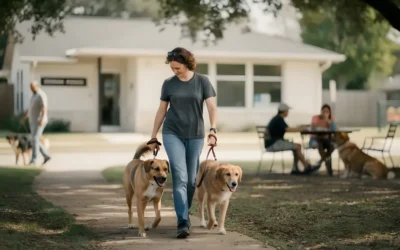
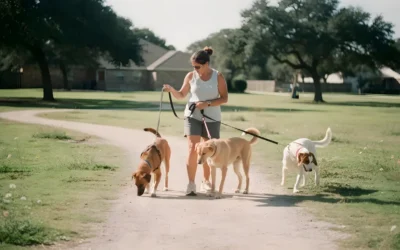
Professional dog walkers and pet sitters are held to the same leash law standard as individual pet owners. There is no exemption for paid professionals. In practice, this means every dog being walked must be on a leash in public, and the walker is responsible for maintaining control throughout the walk.
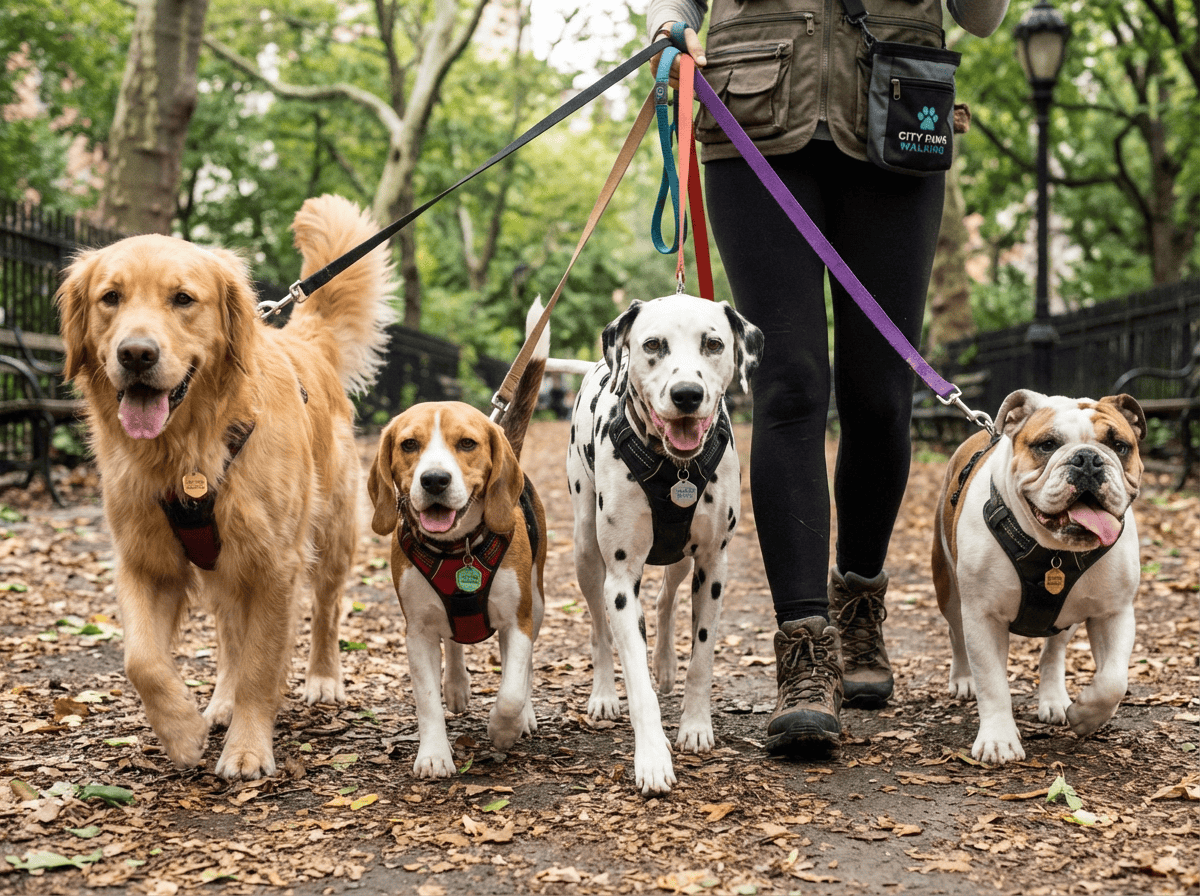
For professional walkers, the stakes are higher in one important way: they are walking dogs they may not know as well as the owner does. Reactive dogs, dogs with strong prey drives, and dogs that are uncomfortable around strangers all require experienced handling on a leash.
On retractable leashes: The ordinance does not specify leash type, but retractable leashes are a practical concern. A 16-foot cord with the dog at full extension gives very little control if another dog or person approaches suddenly. Many professional pet care providers avoid retractable leashes on public walks specifically because of the reduced control they offer, especially in neighborhoods where off-leash dogs or heavy foot traffic are common.
Liability: If a dog bites someone while in the care of a dog walker and that dog was not on a leash, the walker faces personal liability in addition to any ordinance citation. A dog running at large is considered evidence of negligence in Texas, which simplifies the injured party’s path to a civil claim.
💡 Before hiring a dog walker, ask whether they are bonded and insured.
Bonding and insurance protect you if something goes wrong during a walk. In Texas, a dog running at large is evidence of negligence, which means an uninsured walker who loses control of your dog could leave you partially liable for any resulting injury or property damage. A professional service that carries general liability coverage provides a layer of protection that a neighbor favor or an uninsured gig-platform walker cannot.
Professional pet sitters and dog walkers who are bonded and insured carry general liability coverage that protects both the business and the pet owner in situations involving injury or property damage. That coverage only applies when the walker is operating within standard care practices, which includes leash compliance.
HOA Rules and San Antonio Leash Laws: What Takes Priority
Homeowners associations can impose stricter rules than city ordinances, but they cannot reduce or override them. If your HOA has a leash policy, you are subject to both the HOA rule and the city ordinance at the same time.
Common HOA additions in San Antonio-area communities include:
- Leash length limits: Some HOAs require leashes of 6 feet or less in common areas, regardless of the city’s lack of a length specification
- Breed restrictions: Certain communities restrict specific breeds from common areas or require muzzles in addition to leashes
- Designated relief areas: Some HOAs require owners to use only marked pet areas for waste
- Time restrictions: A few communities have quiet-hours rules that affect when and where dogs can be walked
If you live in Schertz, Converse, New Braunfels, Boerne, or other communities outside San Antonio’s city limits, your municipality’s ordinances may differ from the City of San Antonio’s. The core principle holds across most Texas cities: dogs must be under control in public. But fine amounts, licensing fees, and specific park rules vary.
New Braunfels and San Marcos both have their own municipal codes for animal control. Seguin is governed by Guadalupe County regulations as well as city ordinance. If you are not sure which ordinance applies to your address, Animal Control for your municipality is the best source.
Why Leash Laws Exist (And What They Protect)
The practical reasons behind leash laws are worth understanding, because they reflect real risks that San Antonio dog owners face.
Dog bites and liability. A dog running at large that bites someone creates immediate legal liability for the owner. Texas follows a “one bite rule” in many cases, but allowing a dog to run at large without a leash is itself considered negligence, which means the owner can be held responsible for injuries regardless of the dog’s bite history.
Traffic and injury. A loose dog on a busy street is a hazard to itself and to drivers who swerve to avoid it. The San Antonio metro area has high-traffic corridors in every direction, and dog-related traffic incidents happen regularly.
Wildlife and prey drive. San Antonio and its surrounding areas have significant wildlife populations, including deer, rabbits, and coyotes. Many dogs will give chase without warning. A dog off-leash on a trail can cover a lot of ground very quickly, and not all dogs return when called.
Reactive dogs and dog-to-dog safety. A leashed dog that is approached by an off-leash dog is at a disadvantage. The leashed dog cannot create distance, which often triggers defensive behavior. Keeping your dog on a leash in public protects not just your dog but the dogs and people around you.
Lost dogs. Off-leash dogs that bolt after a squirrel or a car can end up far from home. Every year, Animal Care Services handles hundreds of impoundments of dogs that ran from their owners in the moment. A leash prevents most of these incidents.
Leash Law Compliance Is Part of Professional Dog Care
Every Cathy’s Critter Care dog walker uses a standard leash on every walk. That is not a policy document, it is 27 years of hands-on experience walking dogs across San Antonio, Schertz, New Braunfels, Boerne, Converse, San Marcos, Seguin, and Canyon Lake.
Cathy’s Critter Care has served Greater San Antonio since 1998. The team is background-checked, bonded, and insured, and available 365 days a year including holidays and last-minute requests. Cathy was named Pet Sitter of the Year 2018 by Pet Sitters International (PSI), the largest professional association for pet care providers.
When you hire a dog walker or pet sitter, you are trusting them to keep your pet safe under the same rules you follow. Leash compliance is the baseline, not a bonus feature.
To schedule dog walking services or ask about availability in your neighborhood, call (210) 864-6189 or visit cathyscrittercare.com.
Sources: City of San Antonio Municode Chapter 5, Article I, Section 5-19; City of San Antonio Animal Codes Overview (Animal Care Services); City Council Ordinance Update, September 2025.