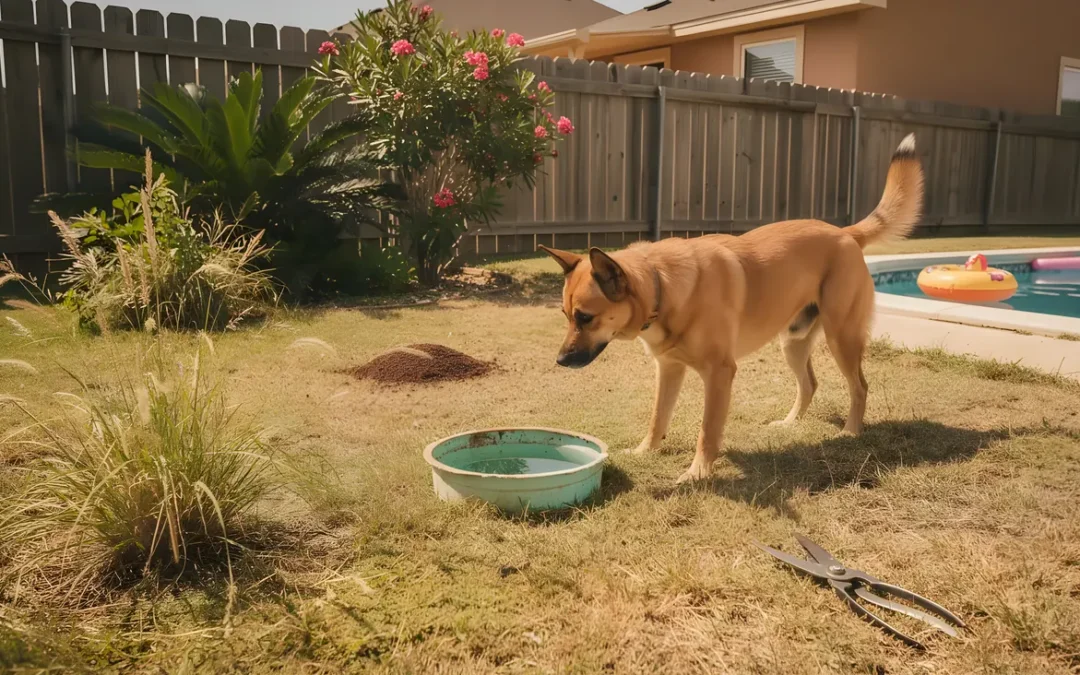
National pet safety guides talk about cocoa mulch and lily plants. Those exist here, but they miss most of what actually lands San Antonio pets in the emergency vet. Over 26 years working in backyards across the greater SA area, our team has seen the same six hazards come up again and again: urban coyotes that scale privacy fences, fire ant swarms that trigger anaphylaxis, venomous snakes hiding in flagstone and mulch, toxic plants common to South Texas landscaping, lawn chemicals that accumulate on paw pads, and standing water that keeps heartworm-carrying mosquitoes breeding from February through November. Heat and pavement get a lot of attention too, and we cover those in detail in our guide to hot pavement and heat safety, but this post is about the hazards that guide does not address.
If you have a fenced yard in San Antonio, Schertz, Stone Oak, Converse, or New Braunfels, some combination of these six hazards is present right now. Here is what you are actually dealing with and what to do about it.
Coyotes Can Scale a Standard 6-Foot Privacy Fence in San Antonio Suburbs
Most San Antonio homeowners feel confident with a six-foot privacy fence. That confidence is misplaced. According to Texas Parks and Wildlife Department (TPWD), coyotes can scale a standard six-foot privacy fence by hooking their front paws on the top rail and pushing off with their hindquarters. A fence with spinning tube devices installed along the top rail (often called coyote rollers) is the minimum physical barrier that actually stops them. A plain six-foot board fence is not enough.
Coyote-Proofing Your Fence: What Works
Stops them
- Coyote rollers on the top rail
- Roller-style fence extensions (add-ons for existing fences)
- Sealing all gaps at the fence base
- Supervised outdoor time at dusk and dawn
Does not stop them
- A plain 6-foot board privacy fence
- Motion-sensor lights alone
- Assuming the yard is safe because it has always been
- Running at an approaching coyote
Denning season (January through June) is the highest-risk window. Coyote aggression increases significantly when a nearby den is active.
Coyotes have established permanent territory across every ZIP code in Bexar County, including Alamo Heights, Shavano Park, and neighborhoods that border greenbelts and drainage corridors. Activity peaks at dusk, dawn, and overnight, and it spikes during denning season, which runs from January through June. During those months, a coyote protecting a den is more aggressive and less deterred by noise or light.
Cats face higher risk than dogs. They are smaller, more likely to be unsupervised outdoors, and less likely to trigger a coyote’s instinct to avoid a fight. Small dogs are also at meaningful risk during early morning and evening.
If a coyote approaches your yard, TPWD recommends hazing: yell, clap, wave your arms, make the animal feel unwelcome. Do not run. Running activates a chase response. The City of San Antonio Animal Care Services (sa.gov) handles wildlife complaints and can provide current guidance on coyote activity in specific neighborhoods.
For prevention, inspect your fence base every few months. Coyotes squeeze under gaps more readily than they scale tops. Do not leave pet food or water outside overnight. If you have a small dog or cat, accompany them outside after dark, no matter how familiar the yard seems.
Fire Ant Venom Contains Solenopsin, a Compound That Can Trigger Anaphylaxis in Pets
Most insects flee when disturbed. Fire ants (Solenopsis invicta) do the opposite. A single nudge of a fire ant mound sends hundreds of workers onto whatever disturbed it, and each ant can sting multiple times. Fire ants preferentially attack thin-haired areas: the eyes, ears, muzzle, nose, and abdomen. A dog that steps on a mound may be stung dozens of times before you realize what happened.
Emergency Signs: Go to the Vet Now
If your dog or cat was stung by fire ants and shows any of these symptoms, this is an emergency vet situation, not a monitor-and-wait situation. Anaphylaxis can develop within minutes.
Sudden drooling or foaming at the mouth
Labored breathing or facial swelling
Vomiting, pale gums, collapse, or seizures
Localized welts and itching without any of the above can be monitored. Anything beyond small welts: call your vet.
Fire ant venom contains solenopsin, an alkaloid compound unique to Solenopsis invicta. In most pets the result is painful welts and localized irritation. In a small percentage of dogs and cats, solenopsin triggers anaphylaxis. Symptoms develop within minutes of stinging and include sudden drooling or foaming at the mouth, vomiting, labored breathing, facial swelling, pale gums, collapse, or seizures. If you see any of these signs after outdoor exposure, this is an emergency vet situation, not a watch-and-wait situation.
Mound-building activity peaks in spring (March through May) and fall (September through November), when temperatures hold in the 70-to-85-degree range. These same windows are when San Antonio pet owners spend the most time outside. New construction neighborhoods in Schertz, Converse, and Cibolo tend to have higher mound density than older neighborhoods: disturbed soil, freshly sodded yards, and recently planted landscaping create ideal conditions for fire ant colonies to establish.
Check fence lines, the area around HVAC units, newly planted trees, and the borders of sidewalks and patios. These are the spots our team looks at first on every property visit.
For yard management, Texas A&M AgriLife Extension recommends the Two-Step Method: broadcast a slow-acting fire ant bait across the entire yard first, then treat individual mounds with a contact insecticide. Spinosad-based baits rank among the lower-toxicity options for pet households when used according to label directions. For mild stings with small welts and localized itching, rinse the area with cool water and monitor closely. Anaphylaxis symptoms require an emergency vet visit, not Benadryl and hope.
Copperheads Are the Most Common Venomous Snakebite in Suburban San Antonio Yards
Most people think rattlesnakes are the primary snake threat in San Antonio yards. They are not. Copperheads (Agkistrodon contortrix) are the most common venomous snakebite in suburban and wooded residential areas of central Texas. Their coloring, a mottled copper-brown pattern, blends almost perfectly into leaf litter, mulch, wood chip borders, and flagstone patios. A dog sniffing along the fence line or under a deck can put its nose within inches of a copperhead before either one knows the other is there. Most bites happen exactly that way.
If Your Dog Is Bitten by a Snake
The first two hours matter most. Follow these steps in order and skip the home remedies entirely.
Do this
- Keep the dog still (movement spreads venom)
- Note the snake’s appearance if safely possible
- Get to an emergency vet that stocks antivenom within two hours
Do not do this
- Cut the wound or try to suck out venom
- Apply ice or a tourniquet
- Give Benadryl as a substitute for vet care
- Approach the snake to identify it
Three venomous species are worth knowing for San Antonio and Bexar County:
The Western Diamondback Rattlesnake (Crotalus atrox) accounts for the highest total number of venomous snakebites in Texas. Active across central, south, and west Texas, its hemotoxic venom causes severe tissue damage, internal bleeding, and organ failure without treatment. The rattle is a warning, but most dog bites happen when a dog sniffs or paws at the snake before an owner can react.
The Copperhead (Agkistrodon contortrix) is the suburban yard bite risk. Its hemotoxic venom is weaker than a diamondback’s, but still requires emergency care. Copperhead bites are seldom fatal with prompt treatment, but the swelling and tissue damage are serious and the window for best outcomes is short.
The Cottonmouth, also called Water Moccasin (Agkistrodon piscivorus), lives near slow-moving water: drainage creeks, retention ponds in subdivisions, and the stretches of the San Antonio River, Salado Creek, and Leon Creek that run through residential areas. Its open-mouth threat display showing a white interior is the identifying sign.
If your dog is bitten by a snake, follow these steps in order:
- Keep the dog still. Movement speeds venom distribution through the body.
- Do not cut the wound, attempt to suck out venom, apply ice, use a tourniquet, or give Benadryl as a substitute for veterinary care.
- Get to the nearest emergency vet that stocks antivenom within two hours for the best chance at full recovery.
- Note the snake’s appearance if you can do so safely, but do not approach it.
Prevention is simple: remove brush piles, wood stacks, and rock piles from yard edges. Keep grass mowed short along fence perimeters. Seal gaps under gates and at the fence base. Avoid letting dogs sniff unsupervised under decks or into dense shrubs at dusk during warm months.
Sago Palm and Other South Texas Plants Cause Acute Organ Failure in Pets
Generic toxic plant lists include daffodils and tulips. Those are real concerns in Minnesota. In San Antonio, the plants worth knowing are the ones people actually put in their yards here, and some of them are far more dangerous than anything on a national list.
Suspected Plant Ingestion
Call the ASPCA Animal Poison Control Center immediately at (888) 426-4435. Do not wait for symptoms. Early decontamination significantly improves outcomes for every plant on this list.
Toxic plants common in San Antonio yards
- Sago palm – acute liver failure; 32-50% mortality without prompt treatment
- Oleander – cardiac glycosides; potentially lethal in small quantities
- Lantana – unripe green berries cause liver damage
- Texas Mountain Laurel – chewing the seeds delivers a full toxic dose
- Chinaberry – 6-8 berries toxic to a small dog; trees drop freely
Sago palm (Cycas revoluta) demands the most urgency. Every part of a sago palm is toxic, and the seeds carry the highest concentration of cycasin, the compound that causes acute liver failure in dogs and cats. There is no safe amount to ingest. Symptoms appear within hours of ingestion, and severe liver failure can follow within 24 to 72 hours. The ASPCA Animal Poison Control Center has historically cited a 32 to 50 percent mortality rate for sago palm cases without immediate aggressive treatment. If you suspect your pet ingested any part of a sago palm, call the ASPCA Animal Poison Control Center immediately at (888) 426-4435 and go to an emergency vet without waiting for symptoms. Sago palms are widely used in San Antonio landscaping because of their drought tolerance and appearance. They are worth removing from a yard with pets, or at minimum fencing off completely.
Oleander is another extremely common choice in San Antonio landscaping, planted for drought tolerance and year-round color. All parts contain cardiac glycosides in high concentrations, including the leaves, flowers, stems, and the smoke from burning clippings. Oleander causes irregular heartbeat, bradycardia, and potential cardiac arrest, and it is considered lethal in small quantities for small dogs and cats.
Lantana is a widely used color plant throughout San Antonio yards. The green unripe berries are the most toxic part and cause liver damage. Dogs that graze along garden borders face the highest exposure risk.
Texas Mountain Laurel is a native shrub used in residential landscaping throughout the city. Its bright red seeds contain quinolizidine alkaloids. The hard seed coat reduces the risk somewhat, but a dog that chews the seeds delivers the full toxic dose to itself. Symptoms include salivation, weakness, respiratory difficulty, and tremors.
Chinaberry trees are naturalized across older San Antonio neighborhoods and commonly found in established residential lots. Orange-yellow berries fall freely from the tree. Six to eight berries are toxic to a small dog.
If any plant ingestion is suspected, call the ASPCA Animal Poison Control Center at (888) 426-4435 immediately. Early decontamination dramatically improves outcomes. Do not wait for symptoms to develop.
2,4-D Herbicide Is Linked to a 200 Percent Higher Lymphoma Risk in Dogs
San Antonio homeowners typically apply pre-emergent herbicides in early spring and again in fall to control crabgrass and broadleaf weeds. These are the same windows when dogs spend the most time outside. The risk pathway is direct: paw contact with a treated surface, followed by grooming.
The compound worth knowing specifically is 2,4-D, the broadleaf herbicide present in most weed-and-feed lawn products. Research supported by the AKC Canine Health Foundation links repeated exposure to 2,4-D with a 200 percent higher risk of lymphoma in dogs and a documented association with bladder cancer. Dogs are more vulnerable than humans because they groom paw surfaces directly after outdoor time, bypassing the skin barrier entirely.
Every registered lawn treatment product carries a re-entry interval (REI) on its label. This is the wait period before pets should access the treated area:
- Fertilizers: 24 to 48 hours, or until watered in and thoroughly dry
- Weed control spray: 48 hours minimum; the surface must be dry
- Insecticides: typically 72 hours; follow the specific product label
If you use a lawn care company, ask for the product name and the REI before each application. Request that treated areas be flagged. When there is any uncertainty, keep pets off treated surfaces for 72 hours and wash paws thoroughly after any outdoor access during that window. Label instructions are not conservative estimates; they exist because the product’s efficacy requires time to bind and degrade to safe levels.
Texas Ranks First Nationally for Canine Heartworm, and Standing Water Drives It
The 2026 American Heartworm Society (AHS) survey ranked Texas first in the nation for canine heartworm incidence. Texas clinics averaged nearly 50 heartworm-positive dogs per clinic, with a confirmed rate of 3.78 percent positive, up from 2.97 percent in 2022. Heartworm (Dirofilaria immitis) has been confirmed in all 254 Texas counties. In San Antonio, the warm South Texas climate means mosquito season runs approximately ten months per year, which means heartworm exposure risk runs almost year-round.
The biology matters here. An infected mosquito transmits heartworm larvae with each bite. Those larvae travel through the bloodstream and develop into adult worms up to twelve inches long inside the heart and pulmonary arteries over six months. By the time a dog shows symptoms, typically a persistent cough, exercise intolerance, and unexplained weight loss, the infection is established and treatment is expensive, prolonged, and carries real physical risk for the dog. Monthly preventative medication is inexpensive by comparison and prevents infection entirely.
Standing water enables mosquito breeding: mosquitoes breed in as little as a bottle cap of standing water. Common contributors in San Antonio backyards include saucers under planters, low spots in grass after rain, clogged gutters, birdbaths that are not refreshed every two to three days, tarps with pooled water, and decorative water features without active circulation. After any significant rain, a quick pass through the yard to empty and overturn anything holding water removes the next generation of mosquitoes before they hatch.
Standing water carries one additional risk worth noting: leptospirosis. Dogs can contract this bacterial infection (caused by Leptospira spp.) by wading in or drinking from puddles, drainage ditches, or slow-moving water contaminated by wildlife urine. Raccoons, rats, and opossums, all common in San Antonio’s greenbelt corridors, are the primary reservoir hosts. Leptospirosis is transmitted by wildlife-contaminated standing water, and symptoms include sudden fever, muscle pain, vomiting, and in serious cases kidney or liver failure. Leptospirosis is also zoonotic, meaning it can transmit from dogs to humans. A lepto vaccine is available and recommended by most San Antonio veterinarians for dogs with regular outdoor exposure.
When You Can’t Be the Eyes on the Yard
The hazards above all assume you are home. Most of the time when a dog runs into trouble with fire ants, a downed plant, or a puddle after rain, the owner is away or inside and did not see it happen. That is where professional pet sitting changes the outcome. Our team does a yard check before letting any dog outside on a visit: fire ant mounds along fence lines, leaf litter that might be hiding a snake, standing water after rain, and anything that looks newly applied to the lawn. We have been doing this in SA backyards since 1998 and we know what this area’s yards look like in March versus October. When you are traveling or working, that’s the difference between a problem caught and a problem that becomes an emergency call.
A Backyard Check Before You Open the Door
Building a quick check into your daily routine takes less than two minutes and catches most of the hazards above before your dog is already in the middle of them.
Scan the fence line for fire ant mounds, especially in the 48 hours after rain and throughout spring and fall. Mounds that were not there yesterday can be fully active this morning. Check along HVAC units and patio borders while you are at it.
During warm months, take a quick look under decks, along rock borders, and in any areas with dense shrubs or wood piles before letting your dog out unsupervised. This is particularly relevant in the evening and early morning.
After any rain event, walk the yard and empty anything holding water: saucers, tarps, birdbaths, and any low spot that pooled. This is a five-minute task that disrupts the mosquito breeding cycle before it starts.
If your yard includes sago palms, oleanders, lantana, Texas mountain laurel, or chinaberry trees, check for fallen berries, seeds, or pods after wind or rain events. Neighbors’ trees can contribute material as well.
Hold off on letting pets into the yard for at least 48 to 72 hours after any lawn chemical application, and when in doubt, ask for the product label and follow its specific re-entry interval.
Our team runs through exactly this checklist on every visit at the properties we care for in San Antonio. If you want a second set of eyes on your yard while you are away, call us at (210) 864-6189.
FAQ
Can a coyote get into a fenced San Antonio backyard?
Yes. TPWD records show coyotes routinely get over six-foot privacy fences by gripping the top rail and vaulting over. A plain board fence does not stop them. Coyote rollers along the top rail and sealed gaps at the base are the minimum effective deterrents. Small dogs and cats should not be left outdoors unsupervised at dawn, dusk, or overnight, particularly between January and June when a nearby den raises aggression.
What should I do if my dog steps in a fire ant mound?
Move the dog away from the mound immediately and brush off ants physically. Rinse the affected areas with cool water. Watch closely for anaphylaxis symptoms: sudden drooling, vomiting, labored breathing, facial swelling, pale gums, collapse, or seizures. These symptoms develop within minutes and require emergency veterinary care. Localized welts without systemic symptoms can be monitored, but if you see anything beyond small welts, call your vet.
Which venomous snakes are most common in San Antonio yards?
In suburban San Antonio yards, copperheads are the bite most likely to happen. Their mottled pattern makes them nearly invisible in leaf litter and mulch. Western Diamondbacks account for the highest total snakebite volume in Texas, while cottonmouths are common near drainage creeks and subdivision retention ponds. If your dog is bitten, keep the dog still, skip all home remedies, and get to an emergency vet with antivenom stock within two hours.
Is sago palm really that dangerous to pets?
Yes. Sago palm (Cycas revoluta) is one of the most toxic plants in residential landscaping. Every part is toxic, with seeds carrying the highest concentration of the toxin cycasin, which causes acute liver failure. Historical ASPCA Poison Control data shows 32 to 50 percent mortality without immediate aggressive treatment. Call (888) 426-4435 right away if you suspect any part of a sago palm was ingested and go straight to an emergency vet. Do not wait for symptoms.
Does Texas really have the worst heartworm problem in the country?
According to the American Heartworm Society’s 2026 national survey, yes. Texas ranked first in the nation with a confirmed positive rate of 3.78 percent at veterinary clinics, up from 2.97 percent in 2022. The parasite is present statewide, documented across all 254 Texas counties. San Antonio’s South Texas climate supports mosquito activity roughly ten months per year, which means year-round prevention is not optional for dogs with any outdoor exposure.
How long should I keep my dog off the lawn after treatment?
Standard fertilizer products: once the application is fully watered in and the lawn surface is dry, generally within 24 to 48 hours. Weed killers and herbicide sprays: keep pets off for at least 48 hours. Insecticides: typically 72 hours. Each product label states its specific re-entry interval. When you are unsure of the product, 72 hours plus a thorough paw wash before re-entry is a reasonable default.
Looking for a pet sitter in San Antonio who checks the yard before every visit? Call us at (210) 864-6189 or visit our contact page.