
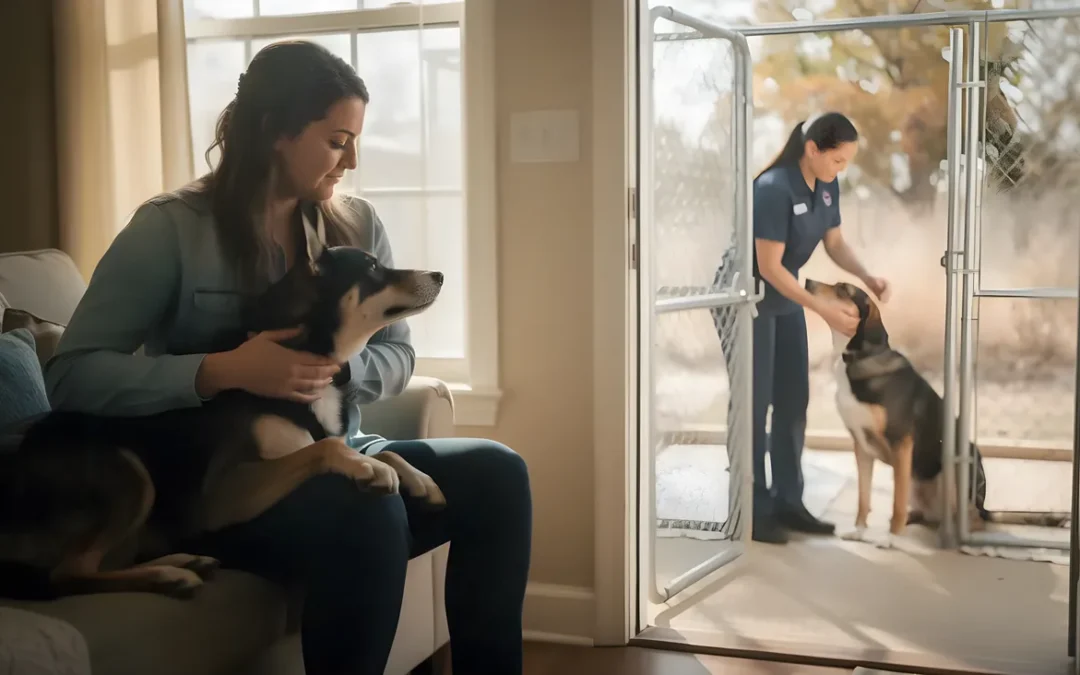
For most pets, in-home pet sitting is the lower-stress choice. That is the direct answer, and there is solid science behind it.
The longer version involves cortisol research, the way cats are wired to respond to territorial disruption, disease transmission in shared kennel facilities, and a cost comparison that is not as one-sided as most owners assume. If you are weighing your options before a trip and want a real answer rather than a hedged “it depends,” this post covers all of it.
What the Research Says About Boarding Stress
Cortisol is the body’s primary stress hormone. It is measurable in blood, urine, and saliva, and it does not lie. When researchers have looked at what happens to dogs placed in boarding facilities, the findings have been consistent and worth understanding before you make a decision.
What the Research Shows
Cortisol levels in kenneled dogs stay elevated throughout the entire boarding stay, not just the first day. This holds true for both puppies and adult dogs.
A second finding goes further: dogs in boarding kennels lose their normal daily cortisol cycle entirely. It is not simple admission anxiety. The body’s stress-hormone rhythm is disrupted and does not recover until the dog returns home.
A peer-reviewed study published on ResearchGate found that average serum cortisol concentration was significantly elevated not just on the first day of boarding, but throughout the entire boarding period, in both puppies and adult dogs. Cortisol levels in kenneled dogs remain elevated from day one through the end of the stay, in both younger and adult animals. This is not an admission stress finding that resolves once the dog settles in.
A separate 2014 study published on PubMed found that urinary cortisol concentrations were measurably higher in kennel environments compared to the home, and identified something more significant: circadian rhythm disruption. Dogs living at home maintain a normal daily cortisol cycle. Dogs in boarding kennels lose that cycle entirely. The body’s fundamental stress-hormone rhythm is disrupted, not merely elevated. Circadian rhythm disruption represents a deeper physiological change than simple admission anxiety, and it persists across the full duration of a boarding stay.
The behavioral signals track with the biochemistry. Owners routinely report that dogs returning from boarding are clingy, lethargic, or digestively upset. Some regress in house training. Others show increased fear behaviors in the first days of boarding, with nocturnal restlessness correlating directly with elevated cortisol.
The honest caveat: not all dogs respond the same way. Dogs that were socialized in kennel environments from a young age, or that stay for shorter periods at quality facilities with enrichment and low animal density, can have neutral to positive experiences. Some dogs find novelty stimulating rather than frightening. If you have a dog who has boarded since puppyhood and comes home unfazed, that matters. But it is the exception, not the rule.
Why Cats Have It Harder
Dogs are social animals whose primary attachment is to people. Remove the person, add a stressful environment, and you get a stressed dog. For cats, the stressor is the environment itself.
Why Home Matters More for Cats
1 in 3 cats does not acclimate to boarding at all, even over a two-week stay.
According to a ScienceDirect study on cats in novel environments, even the two-thirds that do eventually adjust never return to baseline stress levels. Cats that stayed home had lower cortisol throughout. For cats managing kidney disease, hyperthyroidism, or diabetes, the immune suppression that comes with prolonged elevated cortisol adds meaningful medical risk. Veterinary behaviorists near-universally recommend in-home care for cats as a result.
Cats are territorial animals: their sense of security is mapped to a fixed home range, which means a boarding facility’s unfamiliar scents, sounds, and animal presence triggers a stress response before any other variable changes. The familiar scent markers in the corners of each room, the furniture they have marked, the sightlines they have mapped, these are not comforts. They are the architecture of feline safety. A boarding facility removes all of it at once.
A ScienceDirect study on cats in novel environments found that two-thirds of cats acclimated to a two-week boarding stay over time. But one-third did not acclimate at all, and four percent never acclimated during the full boarding period. Critically, even among the cats that adjusted, stress levels never dropped to the baseline of cats who stayed home. Boarding reduced feline stress over time, but it never fully resolved it.
The highest-risk groups are cats with no prior confinement experience, older cats, and male cats. Those are also the most common house cats. For cats already managing kidney disease, hyperthyroidism, or diabetes (conditions that disproportionately affect older cats), elevated cortisol suppresses immune function at exactly the time those animals are least equipped to handle it. Cortisol-driven immune suppression in cats with chronic conditions compounds their medical risk during a boarding stay.
Veterinary behaviorists, specialists who study animal behavior at a clinical level, near-universally recommend in-home care for cats. The territorial biology is the reason. Boarding a cat removes the one variable that gives territorial animals their sense of security: the place itself.
The next section covers what in-home care looks like in practice.
What In-Home Pet Sitting Actually Looks Like
In-home pet sitting means a professional pet sitter comes to your house. That is not a minor distinction. The pet stays in its own bed, eats from its own bowl, follows the same feeding and walk schedule, and sleeps where it always sleeps. The only variable that changes is the human in the home. Routine continuity is the core mechanism that makes in-home care less stressful than kennel boarding.
About Cathy’s Critter Care
Pet Sitter of the Year 2018
Named by Pet Sitters International, the industry’s leading professional association for in-home pet care.
In Business Since 1998
Over 26 years serving Greater San Antonio. A track record you can verify.
20-Person Team
Neighborhood-based sitters with built-in backup coverage. No solo operators, no gaps if someone gets sick.
Background-Checked, Bonded & Insured
Every sitter on staff. You know who has a key to your home, and you are protected if something goes wrong.
Drop-in visits are typically 30 to 60 minutes, one to three times per day depending on the animal’s needs. Overnight stays mean the sitter is present through the night, not just a late check-in.
Where do overnight pet sitters sleep?
In your home. An in-home overnight stay puts the sitter in your spare room or main bedroom through the night, present until morning. Pets that are used to having someone home at night get continuity rather than an empty house.
One practical issue most owners do not think about until it matters: what happens if your sitter gets sick or has an emergency? A solo sitter has no backup. That gap is where independent operators can leave an owner stranded.
Cathy’s Critter Care runs a 20-person team with neighborhood-based sitters, meaning the professional pet sitter assigned to your home is typically local to your area rather than driving across San Antonio. Backup coverage is built into the model. All staff are background-checked, bonded, and insured, which means you know exactly who has access to your home.
Cathy Vaughan, who founded Cathy’s Critter Care in 1998, was named Pet Sitter of the Year in 2018 by Pet Sitters International, the industry’s leading professional association for in-home pet care. That recognition reflects the professional standard of the operation.
For a full picture of what the service covers, see Cathy’s in-home pet sitting services.
The Honest Cost Comparison
Every pet owner searching this topic wants to know what the numbers actually look like. Here they are.
Multi-Pet Households
Boarding charges per animal. In-home pet sitting typically does not.
Two dogs and a cat boarding for seven nights can run $250 to $450 or more depending on the facility and which add-ons apply. With in-home pet sitting, additional pets from the same household are usually billed at a lower incremental rate, and the sitter covers everyone in a single visit. For families with more than one animal, the total cost of in-home care often competes directly with per-animal kennel rates, sometimes coming out ahead.
The national average for dog boarding is approximately $44.99 per night, with basic kennels running $25 to $55 per night and luxury pet hotels reaching $75 to $150 or more. That base rate typically does not include medication administration, extra feedings, or group play sessions, which many facilities bill separately. Kennel boarding costs increase substantially once add-on services are factored in. Many boarding facilities also require a current Bordetella (kennel cough) vaccination, which adds a vet visit cost before the first overnight stay if your pet is not up to date.
In-home overnight pet sitting runs $75 to $150 per night nationally, according to HomeGuide’s 2026 data. Drop-in visits average $20 to $35 for a 30-minute visit and $30 to $50 for a 60-minute visit.
San Antonio rates run approximately 21% below the national average, which makes in-home care more accessible here than the national figures suggest.
Is $50 a day good for pet sitting?
At the national level, $50 per day is on the low end for in-home overnight care, where the market average runs $75 to $150 per night. For drop-in visits, $50 could cover one 60-minute visit or two shorter ones. With San Antonio pricing running below the national average, local rates tend to be more accessible. Get clear on what the rate includes before comparing.
Where the math shifts is multi-pet households. Boarding is typically priced per animal. Two dogs and a cat boarding for seven nights can run $250 to $450 or more depending on the facility and what add-ons apply. In-home sitters typically charge a lower incremental rate for additional pets from the same household. For families with more than one animal, the cost economics of in-home pet sitting often look substantially better than the per-night rate suggests.
The Security Benefit Most Owners Do Not Think About
Most owners researching pet care are focused on their animals, not their house. But this is worth knowing.
A home with a professional in-home sitter present is not an empty home. Mail gets collected. Lights cycle on and off. There is visible activity. Burglars target unoccupied homes. A lived-in appearance, lights that vary, mail that disappears, visible activity, is one of the most effective deterrents for traveling homeowners. The National Association of Professional Pet Sitters explicitly lists this as a benefit of in-home care: sitters bring in mail and newspapers, vary the lights, and keep the home looking occupied.
Professional pet sitters also notice maintenance problems. A water heater leak, an HVAC failure, pest activity in the garage: a sitter who is regularly in your home can contact you before a small problem becomes an expensive one. That is not the primary reason to choose in-home care, but it is a real secondary benefit for owners traveling for more than a few days.
When Boarding Is the Right Call
An honest piece on this topic says when boarding is the better choice. There are real situations where it is.
Highly social dogs that find low-activity environments distressing can thrive in a quality boarding facility with group play and continuous staff presence. If your dog spends the day restless and anxious in a quiet house, a boarding facility with structured activity and supervised socialization may genuinely serve him better than two drop-in visits per day. In-home pet sitting excels at continuity; boarding excels at stimulation for high-energy, social breeds.
Veterinary boarding is the right answer for pets recovering from surgery, on post-operative protocols, or with conditions that require clinical monitoring. Trained medical staff around the clock is what those animals need, and a boarding facility adjacent to a vet clinic or staffed with veterinary technicians provides it. Veterinary boarding is a distinct category from standard kennel boarding and serves a different clinical function.
Sitter availability gaps are real. During major holidays and school breaks, in-home sitters book out early. If a quality sitter is not available, a quality boarding facility is a better fallback than an unknown option.
Dogs that are genuinely kennel-trained and have a positive boarding history may do fine. A dog that has boarded since puppyhood, knows the staff, and comes home relaxed has a different experience than a dog boarding for the first time.
For most pets, especially cats and routine-dependent dogs, staying home is the lower-stress option. Temperament, medical needs, and prior boarding experience all matter. The right answer depends on the specific animal.
What to Look for in a Pet Sitter
The most consistent question across all searches on this topic is some version of: how do I know if a pet sitter is trustworthy? Here are the red flags to watch for, regardless of which sitter you are evaluating.
Looking for in-home pet sitting in San Antonio or Schertz? Call Cathy’s Critter Care at (210) 864-6189 or visit the contact page.
No bonding or liability insurance. If a professional pet sitter cannot show proof of bonding and liability insurance, you are exposed. An accident, a bite, a broken item without insurance means the owner carries the risk. Bonded and insured status is not a formality; it is basic protection for your home and your pet.
No background check. A background check is not about distrusting people. It is about knowing who has a key to your house. Any professional serving a residential client should have one on file.
No verifiable track record. A pet sitter with no public reviews and no references cannot demonstrate a history of professional in-home care. Ask for Google reviews or client references from owners with the same species.
No clear emergency protocol. What happens if your pet needs emergency veterinary care while you are traveling? Who contacts you, and who makes decisions? A professional sitter addresses this in the intake process. If the answer is vague, that is a problem.
No meet-and-greet offered. Reputable pet sitters expect to meet the pet and owner before the first booking. A sitter who skips this step is not taking the job seriously.
Solo operation with no backup. Ask what happens if the sitter gets sick. “I would figure something out” is not an answer. Team-based pet sitting operations with named backup coverage are the professional standard.
If you are in San Antonio, Schertz, Alamo Heights, New Braunfels, or anywhere else across the greater metro area, the same criteria apply. The professional standard does not vary by neighborhood.
Cathy’s Critter Care meets all of these criteria: bonded and insured, background-checked staff, a 20-person team with built-in backup coverage, and a 26-year track record of professional in-home pet care in Schertz and across Greater San Antonio.
Frequently Asked Questions
Do dogs feel abandoned when they are boarded?
Dogs show measurable physiological stress in boarding facilities, particularly in the first three days. Cortisol, the body’s primary stress marker, elevates on day one and remains elevated throughout a boarding stay in most dogs. Whether that registers as “abandonment” emotionally is harder to measure, but the stress response is real, physiologically documented, and persistent across the boarding duration. Dogs that are well-socialized in kennel environments and stay for short periods at enrichment-focused facilities tend to fare better than anxious dogs or those boarding for the first time.
What are the red flags in a pet sitter?
The main ones: no bonding or liability insurance, no background check, no verifiable references, no clear emergency protocol, and no meet-and-greet offered before the first booking. Also watch for solo operators with no backup coverage. If your sitter gets sick and has no team to call on, your pets are left without a professional caregiver. Team-based pet sitting operations with named sitter backups are the industry standard for professional in-home care.
Is $50 a day good for pet sitting?
It depends on what that $50 covers. A $50 rate that includes a full overnight stay looks very different from one that covers a single 30-minute drop-in visit. Before comparing rates, ask what is included: medication administration, multiple pets from the same household, and overnight presence are common add-ons that vary widely between sitters. A lower headline rate with several add-ons can end up costing more than a slightly higher flat rate. Get the full-scope price in writing before committing.
Where do overnight pet sitters sleep?
In your home. An in-home overnight stay means the professional pet sitter is present through the night, typically in a spare room or the main bedroom. It is not a late-evening check-in. The sitter stays until morning, which provides the most routine continuity for pets used to having someone home at night.
Is $100 a day too much for dog sitting?
Not necessarily, depending on what it covers. Overnight in-home sitting at $100 per night falls within or slightly above the national market range, and may be at market for multi-pet households or for sitters in higher-cost areas. If $100 covers a full overnight stay for two dogs in your own home, that compares favorably to boarding two dogs separately at a kennel facility. Ask for a full rate breakdown, including what is included for additional pets, before deciding.
Making the Call for Your Pet
Here is the decision framework, as directly as possible.
For cats: In-home care is the default recommendation. Veterinary research and territorial biology both point the same direction: cats maintain lower cortisol in their home environment than in any boarding facility. Cats do best when their home range stays constant. Keep cats home.
For dogs: Temperament, prior boarding history, trip length, and supervision availability all matter. A routine-dependent dog, a senior dog, or any dog with a history of separation anxiety does better in its own environment with a professional pet sitter. A highly social, kennel-trained dog with a positive boarding history may be fine at a quality facility.
For multi-pet households: The cost math and the logistics both favor in-home pet sitting in most cases. You are not paying per animal, the pets keep each other company in their own space, and the sitter covers the whole household in a single visit.
If in-home care sounds like the right fit for your pets, the next step is finding a sitter who knows your neighborhood and has real backup coverage if something comes up. Cathy’s Critter Care has served Greater San Antonio since 1998, with a full team of local, background-checked, bonded, and insured sitters across the metro area. See what in-home pet sitting covers, or call (210) 864-6189 to talk through what your pets need.
About the Author Cathy Vaughan founded Cathy’s Critter Care in 1998 and has provided professional in-home pet care across Greater San Antonio for over 26 years. In 2018, she was named Pet Sitter of the Year by Pet Sitters International. She leads a 20-person team of background-checked, bonded, and insured sitters serving a 50-mile radius across Greater San Antonio.